

The final week of the Advantage Trunk Show!
The final week of the Advantage Trunk Show!
16 February 2019
- CATEGORY
- INFORMATION
The Advintage trunk show is being held on the second floor of the Ginza branch.
Thank you for visiting us over the three-day weekend, despite the unfortunate weather.
On the day, around 60 vintage watches will be on display, each with its own unique design—all of them truly captivating.
Our trunk show comes to an end this weekend, so please do pop in!
Date and time: Saturday 16 February and Sunday 17 February
Opening hours: 12:00–20:00
Venue: Union Works Ginza, The Upper Gallery
https://www.union-works.co.jp/shop/uppergallery/
Alongside the trunk show, Union Works is currently offering a limited-time sale of advintage vintage watches on its online shop.
The items selected here include three wristwatches from the leading British watchmaker, Smith, alongside three pieces from prestigious Swiss brands; all are elegant vintage timepieces with an English flair that were originally sold on the British market.
A diverse group, each with their own unique background and charm. In this instalment, I’d like to unravelling each of their stories one by one.
▫️SMITHS “DE LUXE” 9KYG CASE / ENGLAND, 1950s
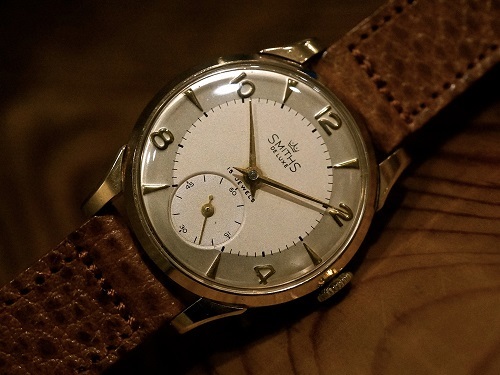
First up is a model from Smith’s best-selling ‘Deluxe’ range, featuring a slightly larger solid gold case. The two-tone dial, with its combination of Arabic numerals and wedge-shaped hour markers, is arguably the most beloved dial design, one that has also been favoured in other Smith watches.
Product pagehttps://unionworks.stores.jp/items/5c5da02ee73a253c9e1d4f68
I would like to take this opportunity to briefly look back at the history of Smith.
Smiths is a prestigious British watchmaker that has produced not only high-quality mechanical watches but also instruments for use in vehicles and other applications. Its history dates back to 1851, when Samuel Smith founded the jewellery and watch retail business ‘S. Smiths & Son’ in London.
The ‘Deluxe’, which has been in production since 1951, is considered the flagship model of Smith’s wristwatch range. Its defining features include not only its highly reliable British-made movement but also its extensive range of designs. Indeed, there is a vast array of case and dial designs available.
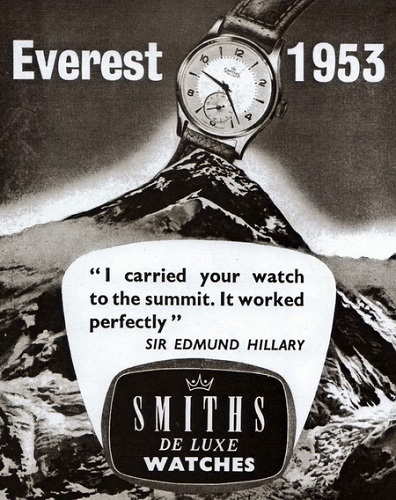
It is said that Smith’s wristwatches first came to public attention on 29 May 1953, when the British Everest expedition led by John Hunt became the first to reach the summit of the world’s highest peak. On that occasion, Sir Edmund Hillary—the first person to reach the summit of Everest—was wearing a Smith ‘Deluxe’ watch on his wrist, a timepiece capable of keeping accurate time even in the harshest of conditions.
▫️SMITHS “ASTRAL” 9KYG CASE / ENGLAND, 1960s
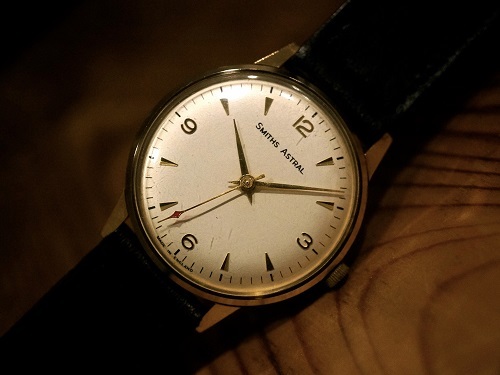
Following on from the ‘Deluxe’ range, the ‘Astral’—which we shall now introduce—was launched and remained a long-running bestseller until the late 1960s. Boasting a range of variations every bit as extensive as the ‘Deluxe’ range, it is characterised by a simple yet modern design that reflected the trends of the time.
This Astral is no exception, featuring a dial design that exudes an even more refined air. The slightly oversized solid gold case has a slim profile, and the understated placement of the hour markers further enhances its elegant appearance.
Incidentally, the name ‘Astral’ was originally a brand name owned by H. Williamson (H. WILLIAMSON LTD.), a manufacturer of marine chronometers that existed in the 19th century; it has a rather unusual history, having later been taken over by Smiths.
Product page https://unionworks.stores.jp/items/5c5d9ebb3b636560aac91ca8
▫️SMITHS “PRE DELUXE” / ENGLAND, 1940s
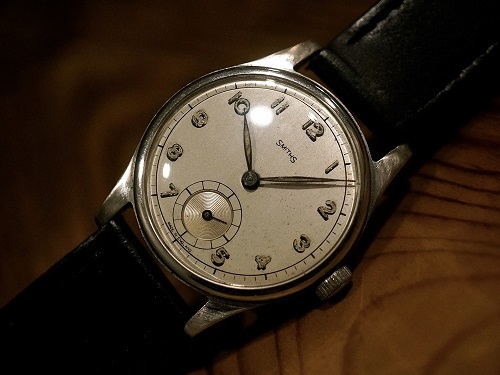
And we must not forget the few early models that were produced for just a few years, from 1947—when Smith first began manufacturing domestic wristwatches—until 1951, when the ‘Deluxe’ was released. As you can see, the dial is simple, bearing only the Smiths logo. It has a primitive look that is clearly distinct from the design of Smiths wristwatches produced after the Deluxe model. Although often referred to as ‘Early Smiths’, one cannot speak of Smiths without mentioning these watches.
All of these cases are crafted by ‘Denison’, a British manufacturer specialising in watch cases, and are characterised by their robust yet elegant silhouette. Denison is renowned as a manufacturer of high-quality cases, having produced cases for numerous prestigious brands, including Rolex.
Product page https://unionworks.stores.jp/items/5c5da1613b636557cac919d7
▫️TUDOR “OYSTER” / SWISS 1950s

Next up are the prestigious Swiss brands: Tudor, Longines and Tissot. First up is Tudor, which has recently re-entered the Japanese market and is making headlines for having officially changed its name to ‘Tudor’. Tudor is known as a diffusion brand that saved Rolex—which at the time was suffering from poor sales due to its exorbitant prices—by using the same Oyster case as Rolex whilst keeping costs down through the use of off-the-shelf movements.
The fact that the brand takes its name from the Tudor dynasty—a family much beloved by the British people—and has adopted the rose, the dynasty’s coat of arms, as its iconic logo, clearly indicates that it is a brand with a strong focus on the British market. It also bears a certain resemblance to the iconic dial design of Smith’s Deluxe range.
Product pagehttps://unionworks.stores.jp/items/5c5da2f4787d8436bd88fff4
▫️LONGINES 9KYG DENNISON CASE & PORCELAIN DIAL / SWISS 1940s
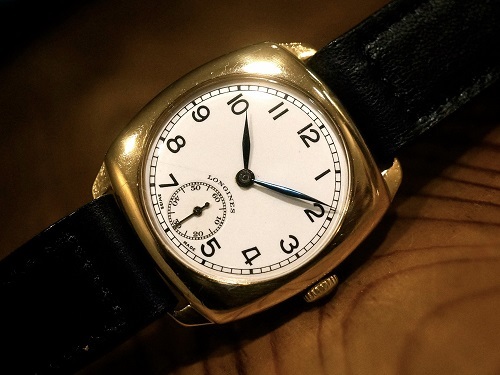
Next, from Longines—a brand renowned for its legendary chronographs and aviation watches—comes a dress watch that harmoniously combines the soft elegance of a solid gold cushion-shaped case with the refined beauty of a porcelain dial. The porcelain dial, which retains the beautiful milky white hue characteristic of the 1930s when it was first produced, features a design reminiscent of railway timepieces, with railway-style hour markers and full Arabic numerals that bear a strong Art Deco influence.
Furthermore, one of the ways in which Swiss watchmakers—including Longines—tailor their products for the British market is by incorporating components from British watch case manufacturers. Connoisseurs recognise them at a glance by their substantial form and deep lustre. This is the quintessential British dress watch.
Product pagehttps://unionworks.stores.jp/items/5c5da5e8e73a2548761d4d4c
▫️Tissot 9KYG Dennison case / Swiss, 1940s

Finally, we have an ‘Antimagnétique’ wristwatch manufactured in the 1940s by Tissot, which remains at the heart of the Swatch Group—the conglomerate that owns watch brands such as Omega and Longines. Naturally, this particular piece was also intended for the UK market and features a robust yet elegant Denison case.
Tissot was founded in 1953. Its long history, spanning more than 160 years, began with a watchmaking business established by Charles-Félicien Tissot and his son, Charles-Émile Tissot, in Le Locle, in the Jura Valley—a region renowned for Swiss watchmaking. From its very inception, the brand has sought to popularise watchmaking through technological innovation. It is particularly known for its exports, centred on the Russian market pioneered by Charles-Tissot, the third-generation head of the family, and as a brand favoured by the emperors of the Romanov dynasty.
I do not think it is an exaggeration to say that the ‘Antimagnétique’ movement—the world’s first anti-magnetic movement, introduced in the 1930s and also featured in this watch—set the standard for the entire watch industry thereafter.
Product pagehttps://unionworks.stores.jp/items/5c5da249c2fc283593620d47
Thank you in advance.
Union WorksGinza Branch、Aoyama Branch
Kurosu