
The Upper Gallery We are holding the event atVintage Watch Trunk Show。
We would like to express our sincere thanks to everyone who visited us on the first and second days!
This weekendSaturday 5 August and Sunday 6 August It’s the final day of the two-day event, but,
The shop window is lined with so many vintage watches that it’s hard to decide which one to choose.
For those of you who haven’t visited us yet, or who are still deciding which one to choose.
We look forward to welcoming you all!
Well then, today…AdvantageMore on the appeal of vintage watches.
When people choose a wristwatch, most select from the current range. Vintage watches often do not even feature among their options. It is said that the initial recall rate for vintage watches in such situations is just a few per cent.
In short, when choosing a vintage watch, you’re unlikely to find anyone else wearing the same one; however, if you can go the extra mile and make a more discerning choice, your attachment to that watch may grow even stronger.
In this article, I would like to introduce some of the design features unique to vintage watches.
〈The lustre of blue steel: the irreplaceable charm of vintage watches〉
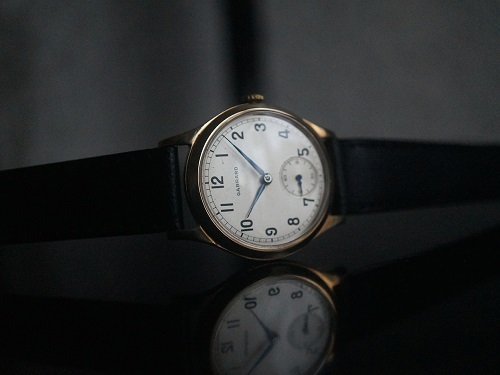
A needle with a blue sheen, known as ‘Blue Steel’
This is a characteristic found in vintage watches, particularly in older models dating from before the 1940s. The deep, iron-blue colour, which conveys a sense of strength, casts an indescribable lapis-blue sheen when it catches the light unexpectedly; many people are surely captivated by this lustre and fall in love with vintage watches as a result.
An ancient technique is employed whereby heat is applied to the iron to create an oxide layer on the surface, thereby preventing rust; this is also a delicate craft that involves discerning the colour of the material—which changes moment by moment as the temperature rises—and the precise timing required to produce the most beautiful cornflower blue.
〈Small seconds or centre seconds〉
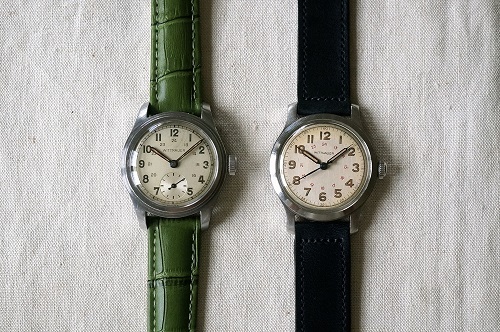
When people hear the word ‘watch’, many may picture a timepiece like the one on the right, with the three hands—hours, minutes and seconds—centred on the dial.
However, going back to the era of pocket watches, it was common for a sub-dial known as a ‘small seconds’—as shown on the left—to be positioned at the 6 o’clock mark. In an era when it was not particularly necessary to read the time to the second, a two-hand watch without a seconds hand was actually considered the most elegant, and it seems that the seconds hand was not regarded as particularly important at that time.
However, throughout the two world wars, the importance of wristwatches increased dramatically, and the situation changed completely. For tasks where measuring and reading time down to the second was crucial—such as soldiers carrying out operations or medical staff taking a patient’s pulse—the small seconds hand proved inconvenient, and demand grew for centre seconds hands, which made it easier to read the seconds. Consequently, the development of new movements specifically for centre seconds hands was set in motion.
Whilst both have their own distinct charms, the fact that the small seconds hand is considered a more classic style stems from this technical background.
〈The charm of an aged dial〉
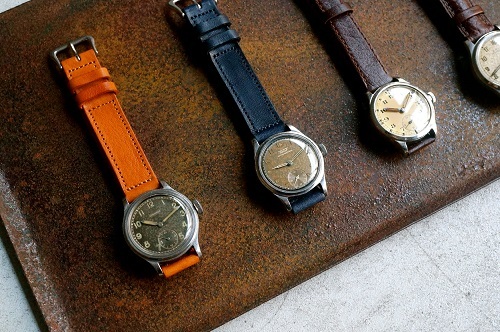
A character developed over time. This, too, is one of the unique charms of vintage watches.
A fox-coloured dial, tanned as if blushing; a black dial with a mirror finish that, as it weathers, gives rise to soot-coloured and copper-coloured hues, as well as a linen-coloured marbled effect created by countless speckles. Each of these is a form of uncontrived, natural beauty.
There is a certain beauty in the patina—much like that found in vintage furniture or well-worn denim. Whilst the ageing of the dial may appear to be damage, it does not significantly affect its functionality. I believe that what makes a vintage watch a ‘one-of-a-kind’ piece is not only its rarity but also the significant influence of its ageing.
<英国時計の証、デニソンケース>
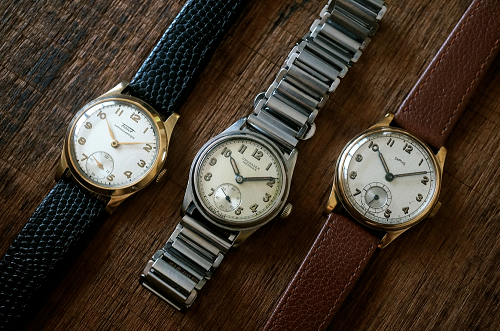
The appeal of British watches is not limited to *Smith*. It is not uncommon to find cases produced by *Denison Watch Case Company*—a manufacturer that specialised exclusively in watch case production at the time—used in shop watches from high-end jewellers and watchmakers operating in the UK at the time, as well as in models from Swiss brands designed for the British market.
Denison watch cases are of exceptionally high quality, having been adopted by global luxury brands such as Rolex and Omega for their models intended for the UK market. Their substantial bodies are characterised by a distinctive, beautifully rounded shape. In particular, the company’s stainless steel—known as ‘Denisteel’—is prized for its elegant, hard-worn quality, reminiscent of sterling silver.
Among the items we have selected for this event, there are several British wristwatches featuring this Denison case. Please do come and take a look in-store.
Furthermore, vintage watches are characterised by the interweaving of the backgrounds and histories of various brands and models, which together give rise to the unique charm of each individual timepiece. We would be delighted if you were to take this opportunity to discover and enjoy that charm for yourselves.