
‘Heel Up’ is a semi-regular feature on the menu—not every day, but a few times a week.
I’ve written an article setting out some of the key points I picked up whilst carrying out the work. I hope this will be of some help if you’re considering a heel lift.
So, first of all, let’s look at the question: ‘How high can heels be?’
In my experience, a height of up to 1 cm can be achieved without any difficulty; the higher it is beyond 1 cm, the more unnatural it looks.
We do not recommend raising the heel by more than 1 cm; however, if the customer’s top priority is to have a higher heel, we do have experience of raising heels to around 2 cm in the past.
However, it is important to note that if the heel is too high, the balance of the shoe may be compromised, which could lead to damage in unexpected places.
Regarding whether the top piece should be replaced when fitting new heel lifts
If the item is brand new, the original top piece may feature a design, so I would prefer to reuse the original top piece rather than replace it, if possible.
That does happen sometimes.
Depending on the structure of the heel, it is possible to reuse the upper and raise the heel on many new pairs of shoes.
This is a sample image.
Heel Up 10 mm (original top piece)
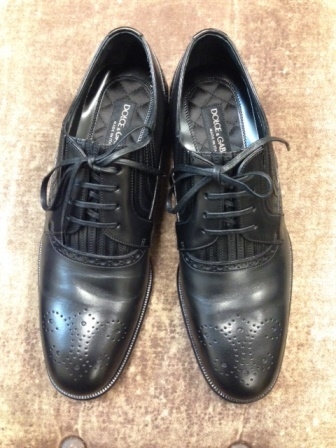
Made by Dolce & Gabbana
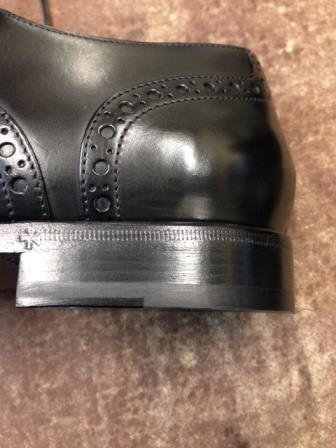
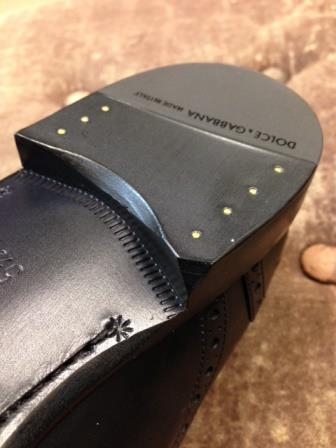
Before
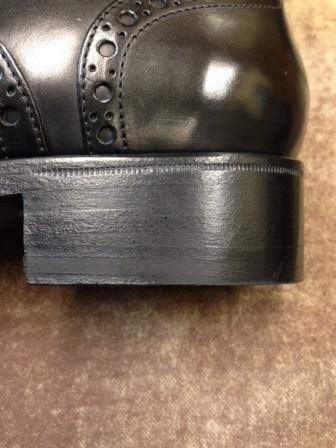
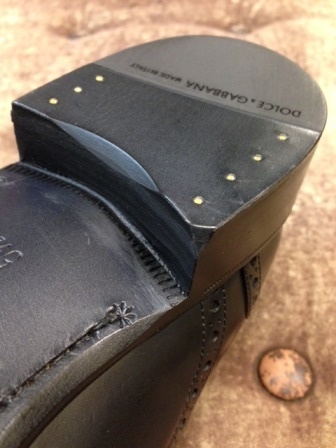
After
Visually, it’s a bit plain…
It may appear that way.
This is because it’s important to make it look as natural as possible, so you don’t end up with a look that screams, ‘I’ve raised the heel!!’
If the original top piece cannot be reused, please select a part that closely matches its appearance from the range of parts we have available, and
This involves an exchange and a repair.
Please contact us for further details.
The hot weather is set to continue, so please look after yourselves.
We look forward to welcoming you all to our factory to see your shoes.
Abe Factory