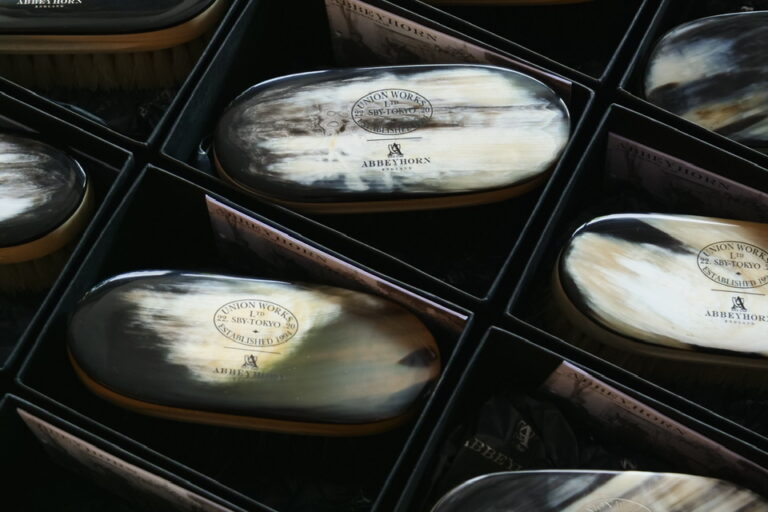


The other day,Union Works’ Approach to Shoe CareWe have introduced [...].
As some of you asked for a bit more detail, I’ve updated this post with some more specific information.
Although there may be some repetition, I would be grateful if you could read on to the end.
Firstly, the purpose of shoe care is ”to keep the leather in good condition so that the shoes can be worn for a long time”.
As leather is used over time, the natural oils are drawn out of the fibres, causing it to dry out and lose its suppleness, which in turn leads to the leather hardening and cracking.
To maintain good condition, it is necessary to replenish moisture and oils.
We therefore consider ”proper basic care (moisturising and leather care)” to be of the utmost importance.
Proper care for the soles involves applying a moderate amount of shoe polish and cleaning them from time to time.
Make sure you wipe it thoroughly with a dry cloth so that the surface does not feel sticky.

There are various types of shoe polish available, but in this blog post we’ll be using a standard emulsified cream for shoe care.
An emulsifiable cream is a product in which the three main components—water, oil and wax—are dissolved using surfactants and organic solvents and then emulsified.
Water (for moisturising) and oil (for leather care) penetrate deep into the leather, providing moisture and suppleness.
The wax remains on the surface; brushing and drying it with a dry cloth smooths the surface and brings out its shine.
Basic care methods are as follows:

First, dust it off

Apply the cream in a thin, even layer

Work it into the leather by brushing.

Finally, give the leather a thorough wipe with a dry cloth to ensure no excess cream remains on the surface, and you’re done.
As it is a simple and straightforward task, it will take around 5 to 10 minutes for those who are used to it.
You do not need to use the cleanser every time, and it is fine to apply several layers of the cream.
This is because the solvent in the cream dissolves the old cream, allowing it to mix with the new cream.
Brushing and wiping it down with a dry cloth will also help to remove dirt.
Generally speaking, as long as you look after them properly with shoe polish, there should be no problem.
However, as you apply layer upon layer repeatedly, old, oxidised oil and hardened wax can reduce the leather’s suppleness, causing it to harden and crack, or
If wax is not wiped off completely and accumulates on the surface, the newly applied cream will not be able to penetrate.


In such cases, it is necessary to thoroughly remove the dirt using a cleaner.
*Please note that whilst a cleaner can effectively remove dirt when used correctly, it may damage the leather if used incorrectly, so care must be taken.
Conversely, using the wrong care methods can sometimes be harmful to the leather.
These are ”a slapdash dry wipe” and ”leaving a mirror finish untreated”.
Dry wiping is the final stage of polishing; it removes any excess cream and smooths the surface to bring out the shine.
If you neglect this, the surface will become sticky and look unsightly; it will also attract dust more easily, which can lead to the growth of mould.
And now, regarding leaving the mirror-polished finish as it is.


Mirror polishing is a finishing technique in which multiple layers of wax are applied to fill in the unevenness caused by the pores, resulting in a flat leather surface that reflects light just like a mirror.
Although it gives a shine that basic skincare cannot achieve, leaving it as it is can lead to various problems.

As the mirror-finished areas are covered with a thick layer of wax, the cream will not penetrate them.
If left untreated, the leather will dry out and deteriorate further.
There is also a theory that it is effective against the rain; certainly, if the surface is coated with wax, it will repel water.
However, it does not cover right up to the edge of the welt.
That is an area where water tends to pool, and it eventually seeps up into the upper.
This is all the more true when the welt absorbs moisture.
If the shoes are made of dry leather, the dye will soak in more noticeably, making it easier for uneven, patchy stains to form.
With leather that retains its moisture, even if it gets slightly wet, the natural oils it contains mean that,
It helps to prevent the leather fibres from swelling and hardening suddenly (resulting in a bumpy stain).
I would say that regular maintenance is also important when it comes to preparing for the rain.
Another key point is to apply a generous amount of cream to the welt as well.
A mirror polish is merely a cosmetic treatment and, fundamentally, does the leather no good.
Leaving matters as they are will lead to various adverse consequences.
Wouldn’t it be best to use these little touches on special occasions, depending on the time, place and occasion?
The phrase ‘High Shine is party make-up’, which I read somewhere, really strikes a chord with me.
Just like make-up, don’t leave it on for too long; remove it once you’ve finished.
(This is by no means a criticism of high-gloss polishing itself. If you’d like, I’d be happy to polish it for you.)
Furthermore, it is difficult and time-consuming to remove a hardened layer of wax using standard cleaning products.
There is a product known as a ‘high-shine cleaner’, which contains a higher proportion of solvents than standard cleaners, and
If used incorrectly, it may damage the leather, so please take care when using it.
If you are concerned about removing the wax yourself, please do not hesitate to contact us.

With daily brushing and basic skincare, the unevenness of the pores will gradually diminish.
This is the process known as ”leather ageing”.
Shoes that have been carefully looked after over time will shine so brightly with just a bit of cream that they look completely different from when they were new; they have a charm all of their own, distinct from a mirror-finish polish, and are a real eye-catcher.
This is exactly what we’re aiming for.

Rather than artificially making it shine in a short space of time, we prioritise the condition of the leather above all else, and
As you spend time with your shoes, you bring out the full potential of each type of leather and grow together with them.
That is the ideal, and it is how Union Works approaches shoe care.
To summarise briefly
・Basic shoe care consists simply of daily brushing, applying cream and using a cleaner from time to time.
・Once you have finished polishing, wipe the surface thoroughly with a dry cloth to ensure no excess cream remains.
・I think using a mirror finish for special occasions, such as on stage, is fine, but it’s important to remove it thoroughly once the scene is over.
That is to say.
It’s turned out a bit long, but I’ve given a rough overview of shoe care.
There are various ways of thinking about this, but I hope you find this helpful.
Thank you very much.
Union Works


