
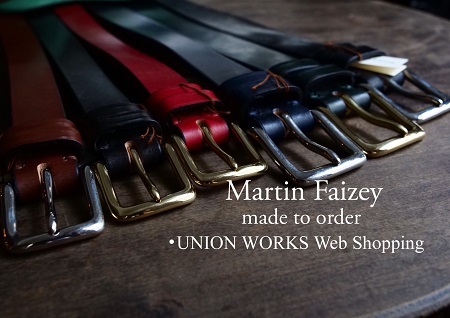
You can customise the colour, width, buckle and size to your liking from a selection of options, but,
Given the wide range of options available, I can understand why you might feel a bit hesitant about placing an order without having seen the actual item...
I would like to share the history of Martin Fagey and the appeal of its belts, drawing on images of the belts being worn and detailed information about them.
About 100 km north-west of London…
A town through which flows the River Severn, the longest river in the UK, and where Worcester Cathedral stands tall‘Worcester’
A little way from the town centre, amidst beautiful countryside where time seems to pass more slowly, stands a single building exuding a sense of charm.

Martin Fagey, who has a collection named after him,‘Martin Faizey’This is the workshop.
Led by Mr Martin, who spent 36 years working at the leather belt workshop of the long-established British brand ‘Daines & Hathaway’, a team of several artisans craft each piece entirely by hand through every stage of the process. These are truly exceptional pieces that not only showcase their craftsmanship but also convey the warmth of handcrafting amidst a precision reminiscent of traditional Japanese crafts.

Among his many creations, the ‘Quick Release’ is a belt that he has continued to produce since his time at Daines, and it can be considered one of Mr Martin’s signature pieces.

The first thing that catches the eye is the distinctive buckle
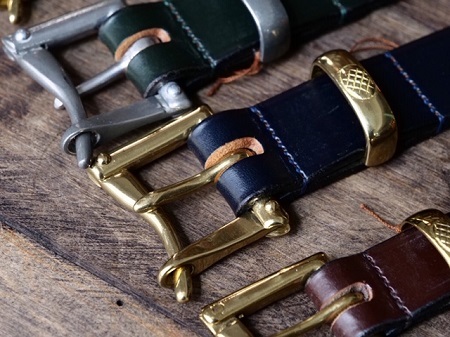
It’s designed to be removed easily, but why was it made in this shape?
The idea originated with the fire brigades of the Victorian era in Britain…
About 180 years ago
The period from 1837 to 1901 was one of rapid economic growth driven by the Industrial Revolution. In particular, the development of the steam engine as a power source and the subsequent growth of mechanised industries such as steelmaking made it possible to shape metal in ways that had not been possible before.
The buckle, which consists of four parts, was originally designed as a fastening mechanism for the equipment used by firefighters at the time; its design ensures that it holds securely in normal circumstances whilst allowing for easy removal in an emergency.
To put it on, you use it just like a normal belt; however, when it comes to taking it off—which is the crucial part—you must first move the lower part, then the side part. Once you’ve moved it this far, the part holding the belt in place is no longer there, and it will drop down under the force of gravity.
Then, simply move the buckle slightly in any direction—up, down, forwards or backwards—and it will come away with a ‘click’.
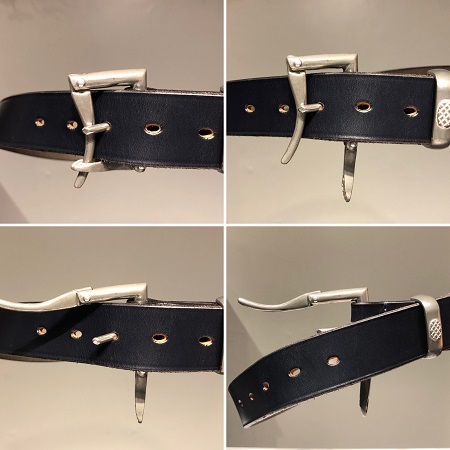
Once you get the hang of it, you can take it off in a matter of seconds! I wonder if anything that urgent will ever actually happen… haha
The material is bridle leather, tanned for 18 months using oak sap, which gives it excellent suppleness and water resistance. Although it is thick, the texture of the leather changes as it is used.
The white powder on the surface is wax that has been absorbed into the leather during the tanning process; as you use the item, it will blend into the leather in response to temperature and movement, bringing out its distinctive sheen, so I think you’ll find it becomes more enjoyable with every use.
The thickness of the leather is standardised at one inch across the board, andApproximately 4–5 mm
The width is1.0 inch is 25 mm
1.25 inches is 30 mm
1.5 inches is 35 mm

1.0 inchIt’s perfect for a smart-casual look and is highly recommended for ‘smart-casual’ outfits,1.25 inchesIt’s versatile enough to be worn with both formal and casual outfits, and1.5 inchesIt goes well with khaki or beige military trousers and rugged denim, for example!

Here are the colour options for bridle leather.
*To be introduced later*‘Bridle Leather Belt’The same applies to the colour tones.

The silver buckle is known as pewter and is made from an alloy consisting mainly of tin.
As it is made of a soft metal, it is characterised by the fact that, with use, it develops slight scratches and small dents, gradually taking on a slightly weathered appearance over time.

The gold-coloured buckle is made of brass—an alloy of copper and zinc—which gradually oxidises when exposed to the air, causing it to turn black or reddish-brown in places.
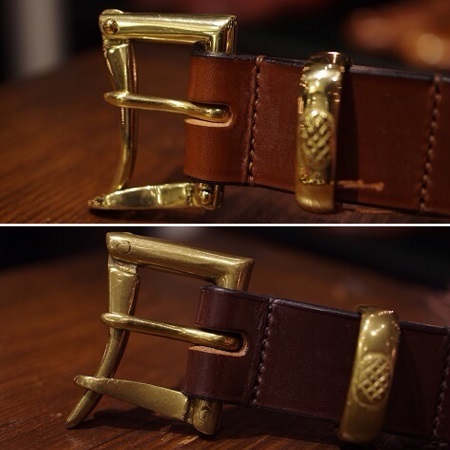
The way metal ages offers a different kind of pleasure to that of leather, doesn’t it? ⭐︎
‘Bridle Leather Belt’
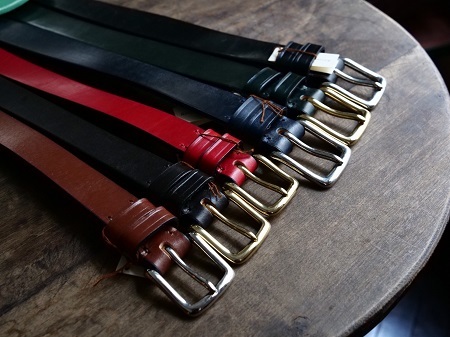
(Previously, bridle leather was only available in combination with the quick-release fastening.)
The buckle on this belt is made of nickel, which is lighter and stronger than pewter, and has a glossy finish. Whilst it does not develop a patina over time, it remains in pristine condition at all times, making it ideal for formal occasions.
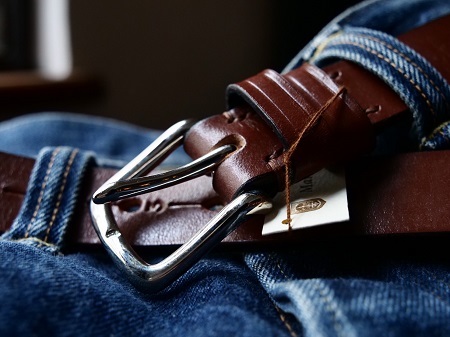
‘I like bridle leather, but with a quick-release fastening, the buckle stands out a bit too much…’
I imagine there were some of you who thought that, weren’t there?
I’d love it if you could take this opportunity to place an order⭐︎
From here on, we’ll be showing you some photos of the items being worn.
First of all,Quick-release, red, brass, 1.0 inch

The waist is accented with a striking red colour that’s perfect for adding a pop of colour, whilst the width is kept to 1.0 inch and the brass buckle adds a neat finishing touch!
I think it’s a rather playful way of dressing.
Dress Belt, DK Havana, Brass

The leather is thicker than that of a standard dress belt, and the buckle is also more substantial.
It seems more suited to trousers made from slightly thicker fabrics, such as cotton or woollen ones for winter, rather than the lighter summer fabrics.
Saddle leather belt, 1.25 inches, H. Brown
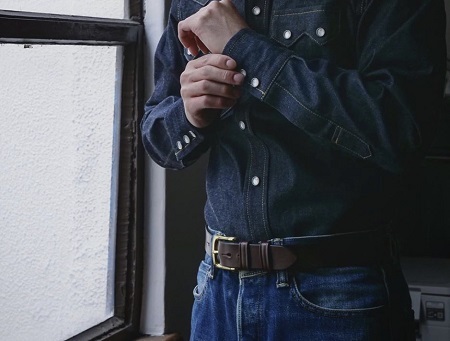
All the belts Mr Martin makes are solidly constructed, and I think their striking presence is their greatest appeal.
I hope this proves of some help to those of you who were unsure about what to order.
Please take care on your way here!
Thank you very much.
Ginza Branch, Takiguchi