
UNION PLANTS: An Introduction to Their Charm and How to Care for Them☆
UNION PLANTS: An Introduction to Their Charm and How to Care for Them☆
11 May 2017
- CATEGORY
- Daily Events
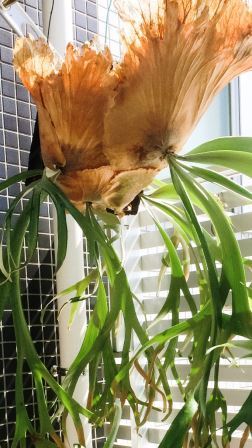
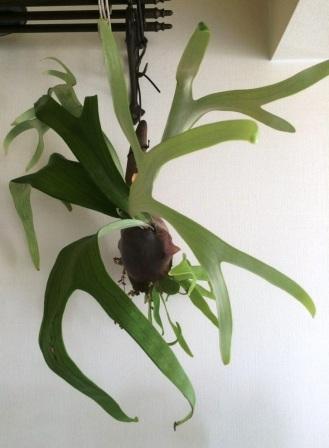
The plant pictured above is known as the bat plant. Connoisseurs call it the ‘Bikaku’ fern. Its scientific name is Platycerium.
Its greatest appeal lies in its two types of leaves: water-storing leaves and spore-bearing leaves.
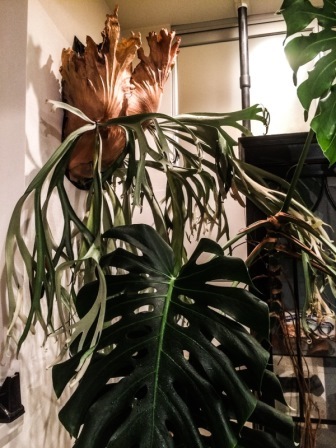
In the image, the large, withered structure at the top is the storage leaf, whilst the one stretching out in a long, slender shape towards the bottom is the spore-bearing leaf.
The new leaves of the water-storing plant are a truly beautiful shade of green, and the sight of them unfurling is simply breathtaking. However, at a certain point, their growth stops, they begin to turn brown at the base, and they wither away all too suddenly.
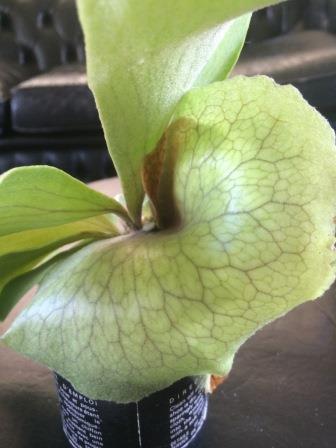
(A water-storing leaf trying to wrap itself around a jar of John Lobb cream. It’s the one that looks like a balloon, stretching from the top right to the bottom left.)
As the next new leaf withers, it wraps around the one before it, continuing to grow whilst the layers stack up like a mille-feuille. It is said that the many layers of withered, water-storing leaves act like a sponge, serving to store water.
The growing green leaves, which store water, are incredibly delicate and fragile. I take great care never to touch them with my hands.
And now, the spore-bearing leaves.
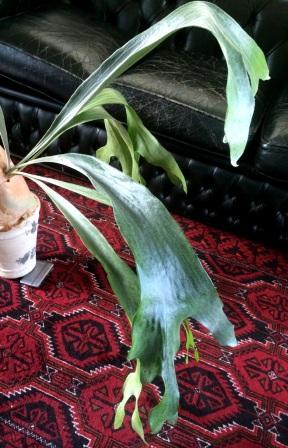
These shoot out in droves from the base of the water-storing leaves. You need to take care of them whilst they’re young, but once they’ve established themselves a bit, they become quite hardy.
As it grows larger, it takes on a beautiful, white powdery coating—much like the bloom found on bridle leather—across its entire surface, whilst its tips become densely covered in brown spores. This is fascinating too!
However, as it may get on your clothes or stain your room, we advise those who are particular about such things to refrain from purchasing this item.
Although they last much longer than water-storing leaves, at a certain point they slowly turn yellow, gradually becoming brown, then dry and brittle, before eventually falling off the plant of their own accord.
(I try to cut them off as close to the base as possible with scissors once they’ve turned slightly yellow. This is so the plant can channel its energy elsewhere. The remaining base will fall out cleanly from the root just by touching it two or three weeks later.)
Below, I’ll be sharing some care tips; however, I’m no expert in this field. Nevertheless, drawing on my experiences and observations over the past eight years—since I first started in 2010—I’ll do my best to explain things as clearly as possible, so I hope you’ll bear with me.
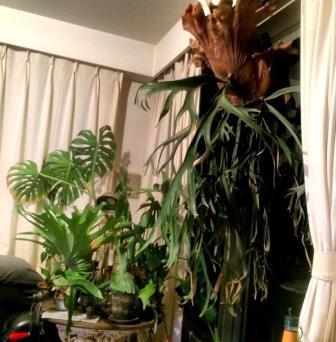
Sunlight and Temperature
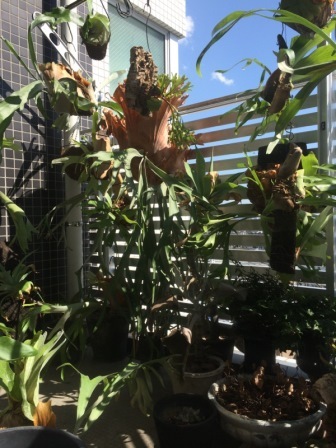
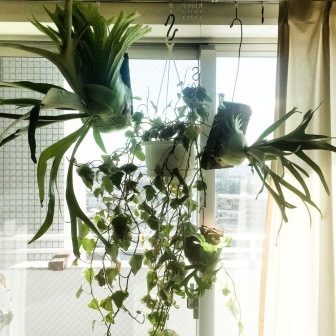
I let them bask in the sun as much as possible, except during the midday heat of midsummer. I think they’ll grow much more vigorously outdoors (on a balcony, for example), but whilst the plants are still small or immediately after repotting, a sunny spot indoors—by a window or even behind a lace curtain—should be fine, shouldn’t it?
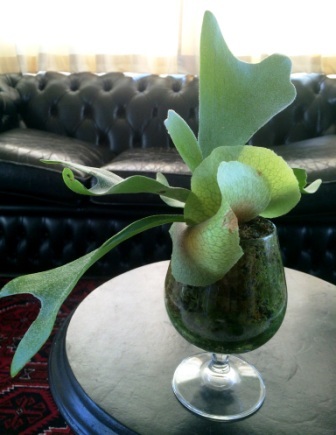
*Please note that UNION PLANTS also offers arrangements in wine glasses and other vessels that are not particularly stable. These are best suited to indoor settings where there is little risk of them being knocked over or broken by draughts or the like.
*Please note that exposure to direct sunlight in the height of summer may cause ‘leaf burn’. This is similar to a burn, causing the leaves to turn brown and become damaged.
*On days when a typhoon is set to make a direct hit, it is best to bring your plants indoors. This will prevent damage to the leaves and stop the plants—or the pots they are in—from toppling over.
Here in Tokyo, from April to the end of October, they are generally kept outdoors or by a sunny window.
Once the minimum temperature drops below 10 degrees, you can bring it indoors. It’s best to place it somewhere that gets plenty of sunlight.
It appears to stop growing and go into dormancy in the depths of winter. Water sparingly and keep the soil on the dry side.
About Watering
For items such as cups, glasses, bottles and tins (provided they do not have a hole in the base), lift them up and if they feel ‘light!’, submerge them slowly, quietly and gently in a bucket, washbasin, wine cooler or whatever you have to hand. Once no more bubbles are rising, they are sufficiently submerged, so lift them out.
Then turn it upside down to drain off any excess water.
*If there is a risk that the plant may not be firmly secured in the pot, gently support it with your hand to prevent it from falling out whilst draining off any excess water.
As for hanging items attached to driftwood or hego boards, if you pick them up and think, ‘They’re so light!’, gently and quietly submerge them in the water.
*Cups and glasses without holes in the base retain water best, followed by pots with holes in the base, and finally hanging pots. However, please note that the risk of root rot also increases in this order, so care must be taken.
Spring and autumn are the growing seasons for plants. Please check on them every day. If they are indoors in the depths of winter, it should be fine to keep the air slightly dry.
‘Leaf misting’ refers to spraying the plant with a misting bottle. UNION PLANTS really love leaf misting, so please do it every now and then whenever you remember.
*I believe the main cause of Platycerium plants dying is the winter cold, followed by a lack of sunlight, and then root rot caused by overwatering. Please be careful not to over-tend or over-handle them.
About Fertiliser
I don’t think it’s particularly necessary. Every now and then, on a whim, I might add a tiny bit of liquid fertiliser (such as Hyponex) to the water, or place in or mix in some slow-release tablets designed for houseplants, but I don’t really notice much of a difference.
About Pests
Those pesky scale insects can sometimes appear on the spore leaves. They are round, brown things about 2 or 3 millimetres in diameter. They don’t move.
These are harmful insects that suck the sap from the leaves and can soil the floor with their droppings. I get the impression they might appear if the air circulation is poor, but I’ve actually seen them on plants that were left out in the open throughout the height of summer????
They’re quite hard to spot, but when you realise there are quite a few of them, it can be rather disheartening. Apparently, there’s no medicine that works on them. You can easily scrape them off with a toothbrush. Wiping them away with a tissue is also effective.
If there seemed to be too many on a single spore leaf, I have sometimes cut it off at the base—leaf and all—and thrown it away.
If you absolutely cannot stand insects, you might be better off not buying this.
That is all.
I will do my best to answer any questions from those who have already purchased the product or are considering doing so, so I would appreciate your understanding.
Thank you very much.
Union Works
Kazuyasu Nakagawa